Custom CRM development
Custom CRM development for teams that outgrew the template.
A CRM with your pipeline stages, your fields, and your follow-up rules, connected to the email, calendar, and accounting software you already use. Fixed price, code you own.
Fixed price after a free look at how you sell today. Most of our full systems land between $5,000 and $40,000.
A call, a text, an email. One customer.
Three places, one customer. Sample data.
- Scattered todayA sticky note, a text on someone's phone, an email in a shared inbox.
- One customer cardEverything about the customer in one place, in the order it happened.
- The next step is on itA reminder you can tick off, so the follow-up does not depend on memory.
Nothing lives only in someone's head.
Interactive example with a fictional customer. Nothing is sent anywhere.
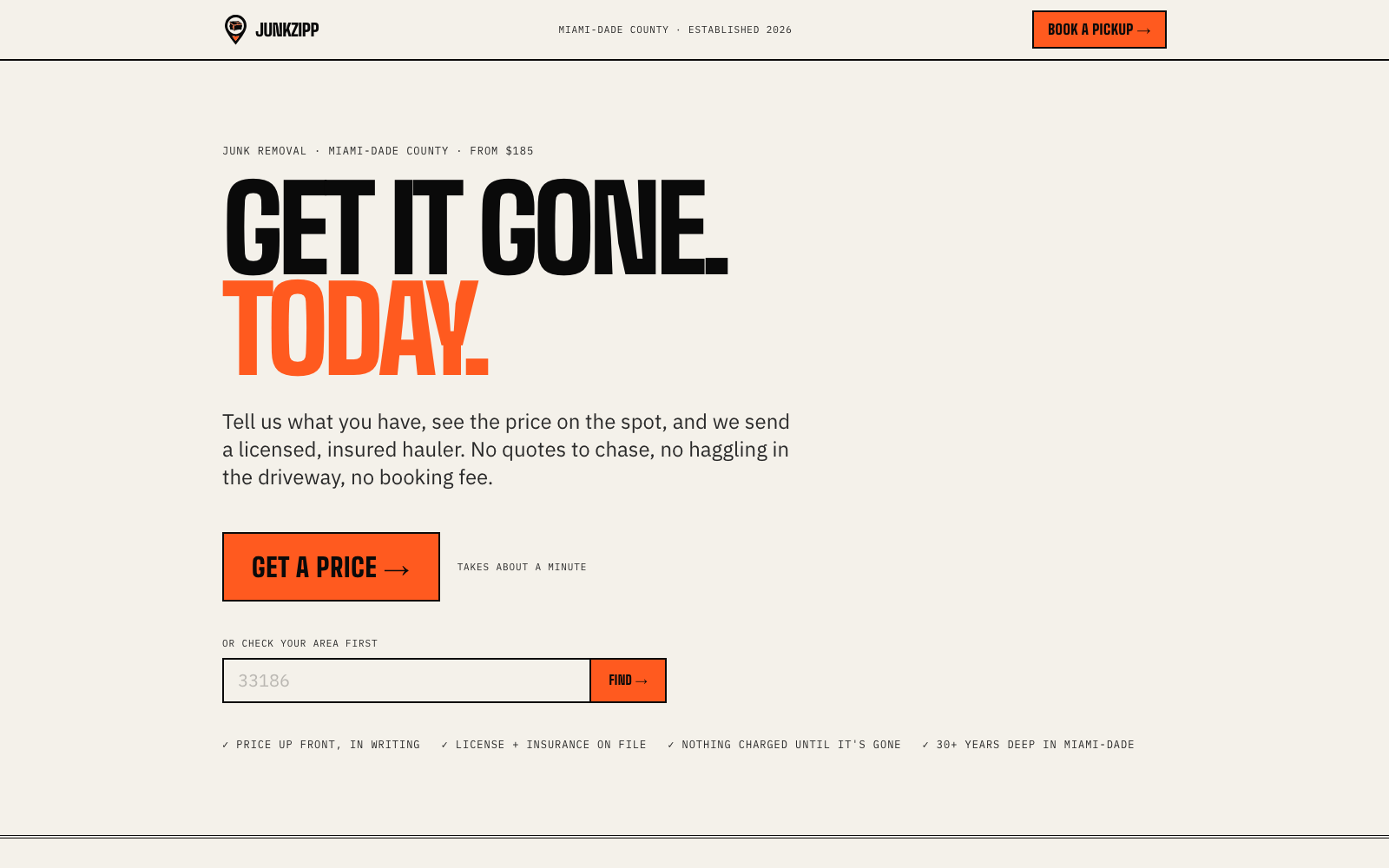
JunkZipp. Bookings, customers, and jobs in one place for a junk removal service, with a hauler app behind it. Built and run by 0ARCH.
Bookingone minuteWhat goes into a custom CRM
Custom CRM development services usually cover these pieces. You pick the ones your sales process needs, and nothing else gets built.
When a custom CRM makes sense
HubSpot, Salesforce, and Zoho are good products, and for a lot of teams they are the right answer. The custom conversation starts when the per-seat bill keeps climbing, when your process does not fit the pipeline the tool ships with, or when half the fields on screen are ones nobody uses. We wrote out the signs in custom CRM vs HubSpot.
It also makes sense when the CRM is really the middle of something bigger: jobs that get scheduled, crews that get dispatched, invoices that go out. At that point you are building an operations system with a CRM inside it, and the off-the-shelf tools get stretched. Our custom web apps and internal tools page covers that wider shape.
What it costs and how long it takes
A custom CRM is priced as a fixed scope. The count of pipelines, integrations, and user roles moves the number more than anything else. We have written up the ranges in how much it costs to build a custom CRM and compared them against the subscription route in CRM implementation cost. Both posts end with a short estimate form: three picks and one line about your business, and you get a real range within a business day.
On time, how long a custom CRM takes to build walks through the phases. The short version: you see a working first milestone early, usually the pipeline and contacts, and the rest is delivered in pieces you can use while the build continues.
How the work runs
It starts with a look at how you sell today: where leads come from, what a rep does with one, and where information gets lost. That turns into a written scope and a fixed price. We build the pipeline and contacts first, you use them, and the integrations and reports follow. At handover you get the code, the database, and the documentation. No per-seat fees, and support after launch is optional. If you are still deciding between building and subscribing, build vs buy has the questions we ask.
Questions people ask
How much does custom CRM development cost?
It is a fixed price per scope. Most of the full systems we build land between $5,000 and $40,000, and a CRM sits inside that range depending on pipelines, integrations, and user roles. The cost posts on this page break it down, and the estimate form at the end of each one gets you a real range within a business day.
How long does it take to build a custom CRM?
You see a working first milestone early, usually the pipeline and contacts, and use it while the rest is built. The delivery plan comes with the scope. The post on how long a custom CRM takes covers each phase.
Can we migrate from HubSpot, Salesforce, or Zoho?
Yes. Contacts, companies, deals, and notes export from all three, and the migration is part of the scope. We run the old and the new side by side until you are satisfied nothing was lost.
Does it connect to QuickBooks and our email?
That is usually the first integration. QuickBooks, Google Workspace, Microsoft 365, and most phone and calendar tools have connections we can use. We check access and permissions before quoting.
Who owns the CRM?
You do. The code, the data, and the hosting are in your name. No per-seat fees, no lock-in, and anyone can maintain it after us.
Is a custom CRM overkill for a small team?
Sometimes. If a free tier covers your process, use it, and we will say so on the first call. Custom pays off when the process is yours and the subscription keeps fighting it, or when the CRM is the front of a larger operations system.